
stories behind my favorite diamonds
Featuring photomicrographs from my laboratory and extraordinary diamonds I’ve studied and written about.
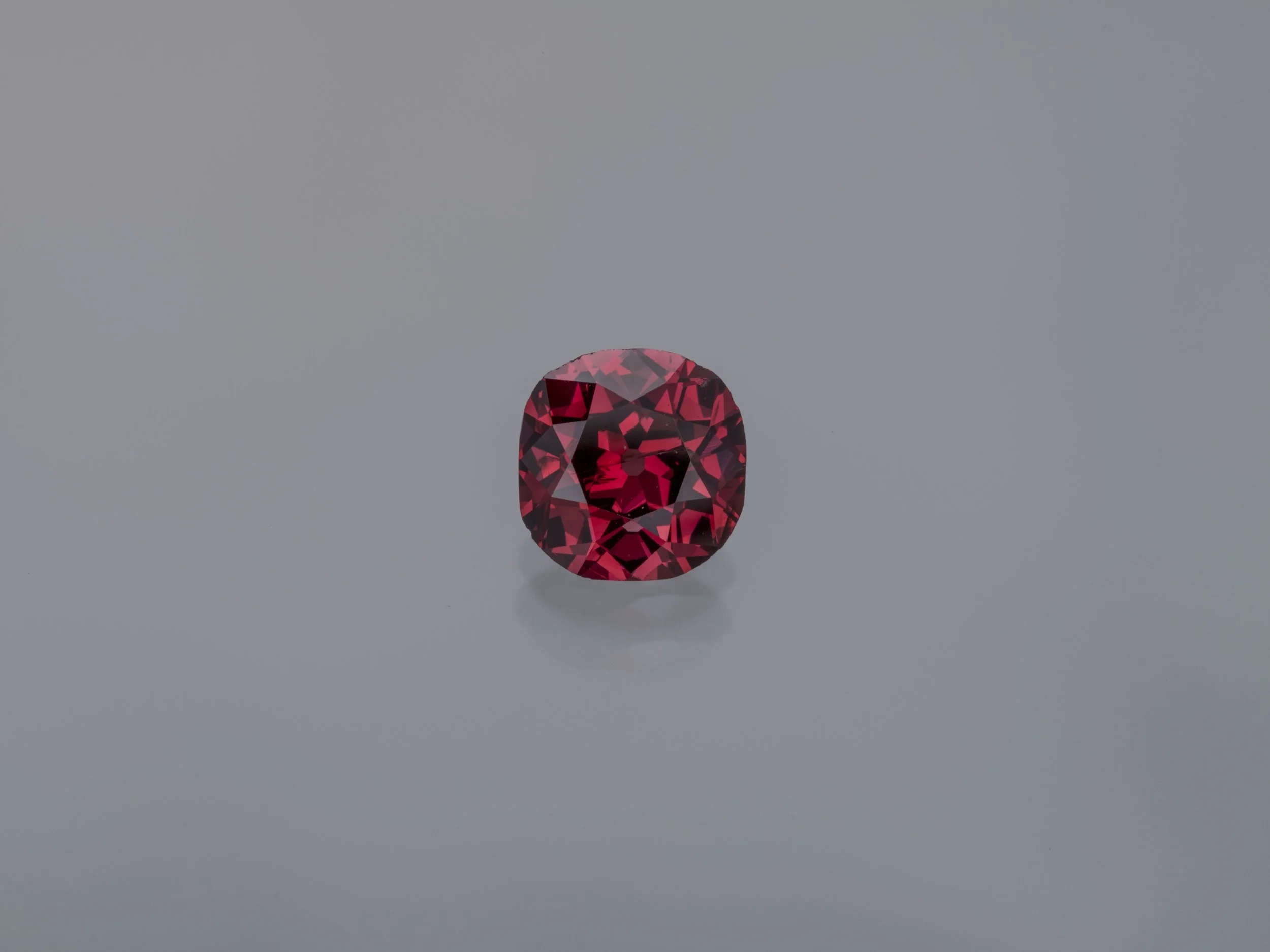
Image courtesy of the Smithsonian National Museum of Natural History.
The world’s largest pure red diamond on public display and one of the rarest natural diamonds ever scientifically studied.
Report Type
Natural Colored Diamond Report
Issued
July 14, 2023
Carat Weight
2.33 ct
Color Grade
Fancy Red
Color Origin
Natural
Shape & Cutting Style
Old Mine Brilliant
Clarity Grade
I₂
Measurements
8.13 × 7.95 × 4.91 mm
Current Collection
National Gem Collection, Smithsonian National Museum of Natural History
GIA Natural Colored Diamond Report
*A photomicrograph is a photograph or digital image taken through a microscope or similar device to show a magnified image of an object.
Each of these photomicrographs was captured using a GIA 30X Microscope 🔬 and an iPhone 📱(except where noted).
FUN FACT:
Did you know that for centuries, diamonds have been the most concentrated, portable form of wealth known to humankind?
UNDER THE MICROSCOPE
![Featured here is an amazing photomicrograph of a rough diamond so tiny it was glued to the head of a pin [for scale, it was the size of a piece of coarse salt]! Despite the small size, you can clearly see trigons ^^^ which are surface feature…](https://images.squarespace-cdn.com/content/v1/5f079f8d11724770e1ac7db1/1596298785463-1NRS03VQEXGNEGW832O2/DB5983DF-3135-43EA-8B5A-0DA8BBA7B4FB_1_201_a.jpeg)
Rough Diamond Crystal
Featured here is an amazing photomicrograph of a rough diamond so tiny it was glued to the head of a pin [for scale, it was the size of a piece of coarse salt]! Despite the small size, you can clearly see trigons ^^^ which are surface features that occur during the diamond’s growth process deep within the Earth's mantle. Trigons can be used to distinguish rough natural diamonds from laboratory grown diamonds. Some diamond polishers will leave a trigon on a finished diamond for this reason.
In the industry, we call a trigon that is intentionally preserved on a polished diamond a “natural’.

Photo Credit: California Diamonds
Two separate faces of a rough diamond
SPECIFICATIONS
Color: Orange
Clarity: IF [Internally Flawless]
Carat Weight: 0.20
Shape: Mackle
Origin: Angola

A Diamond Can Break
The diamond pictured here was the victim of an unfortunate accident. Diamonds are the hardest, natural substance known to man. Despite this fact, I managed to fracture this diamond while it was set in a beautiful platinum ring. Why did it break? Diamond is formed in the cubic crystal system and has four perfect and easy cleavage directions. A cleavage plane is the weakest direction in the molecular arrangement of the crystal. If a diamond is struck along the cleavage, it can fracture!
Moral of this story:
Diamonds are not indestructible.

A Diamond Inside a Diamond
This is a photomicrograph of a brown diamond with another diamond which formed inside!
Look at the assorted trigons ^^^ on the trapped diamond.